
The President’s Porch: A Reflection on Black History Month
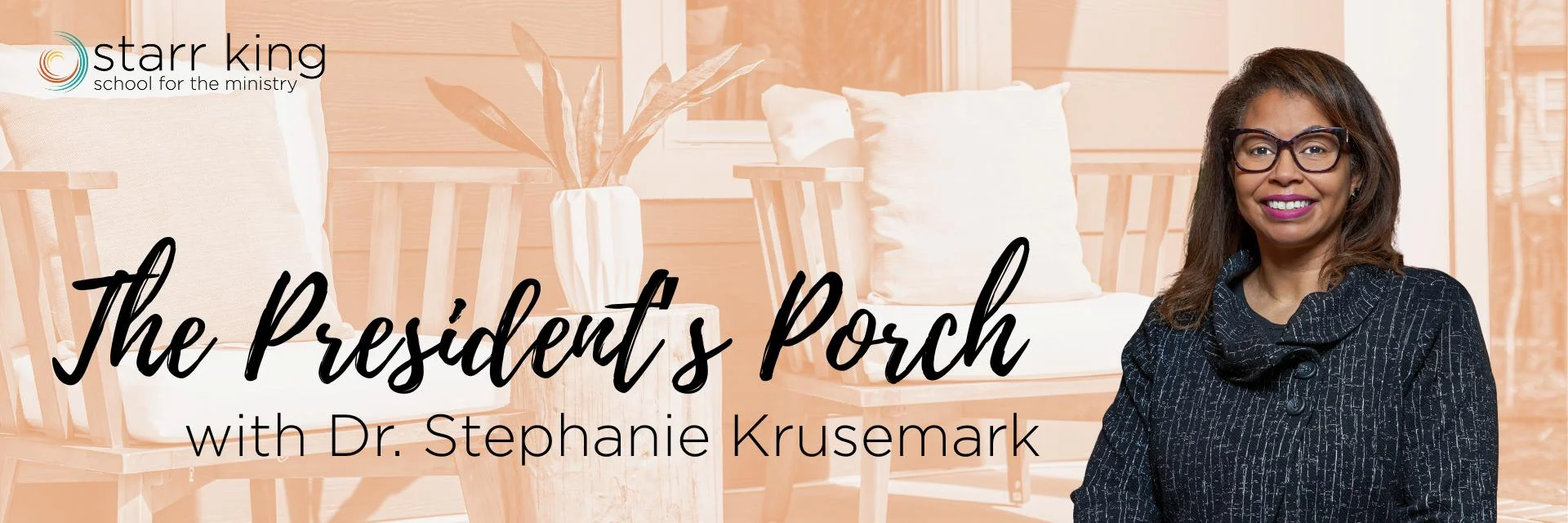
For this month’s installment of the President’s Porch, on the last day of Black History Month, I invite us into reflection as we honor the 100th anniversary of Black History Week and consider its enduring impact on the Starr King community and our shared call to ministry.
When Dr. Carter G. Woodson established what began as Black History Week in 1926, he did so in a nation marred by overt racism and systemic injustice. At the same time, African American life was being reshaped by the cultural flourishing of the Harlem Renaissance and the profound demographic shifts of the Great Migration. Dr. Woodson envisioned a time when Black people could not only learn their history, but celebrate it—marveling at the depth, resilience, and brilliance of their heritage. His work challenged distorted and racist narratives, insisting that Black history was essential to American history.
Fifty years later, in 1976, following the height of the Black Power Movement, Black History Month was officially recognized nationwide—an achievement Dr. Woodson did not live to see. Yet his courage, strength, perseverance, and prophetic imagination made that moment possible. His life reminds us that transformative change is often born of long struggle and deep love for one’s people.
Dr. Woodson’s legacy extends beyond a commemorative month. He founded the Association for the Study of African American Life and History and created publishing avenues to ensure Black scholarship would thrive. He became the second African American to earn a doctorate from Harvard University, following Dr. W. E. B.
Du Bois. His life embodied intellectual excellence yoked to moral conviction—a commitment to education not as personal achievement alone, but as a tool for collective liberation.
At Starr King School for the Ministry, we understand education as sacred work. We educate to counter oppression. We form leaders who are prepared to speak truth to power, to resist injustice, and to build beloved community with love at the center. Black History Month calls us not only to center African American experience, culture, and heritage, but to recommit ourselves to the transformative power of theological education rooted in justice.
What might it look like for each of us to follow Dr. Woodson’s example—to recognize what is missing in our world and to respond with courage and creativity? What impact might our students have as they carry forward this legacy into congregations, communities, movements, and institutions? I dream of graduates who, inspired by their ancestors and equipped by their formation here, will help reshape the moral imagination of our society.
As we reach the close of Black History Month, may we continue learning. May we deepen our appreciation for African American culture and its profound contributions to our shared national story. And may we renew our commitment—as a theological community—to educate, to organize, and to love in ways that dismantle oppression and nurture the beloved community.
______________________________________________________________________
On a personal note, as an African American woman, this commemoration is not abstract for me—it is ancestral. I carry within me the stories of those who survived what was meant to break them, who cultivated brilliance in the face of exclusion, and who insisted on their humanity in a nation that often denied it. Black History Month is both remembrance and resistance; it is a sacred affirmation that my history, my culture, and my very being are worthy of study, celebration, and reverence. Dr. Woodson’s vision speaks personally to me because it echoes the faith of my foremothers and forefathers who believed that education, faith, and community could bend the arc of history toward justice. Their resilience fuels my ministry, deepens my commitment to this work, and strengthens my resolve to ensure that future generations of Black women and girls see themselves not at the margins of the story, but at its vibrant and powerful center.
______________________________________________________________________